
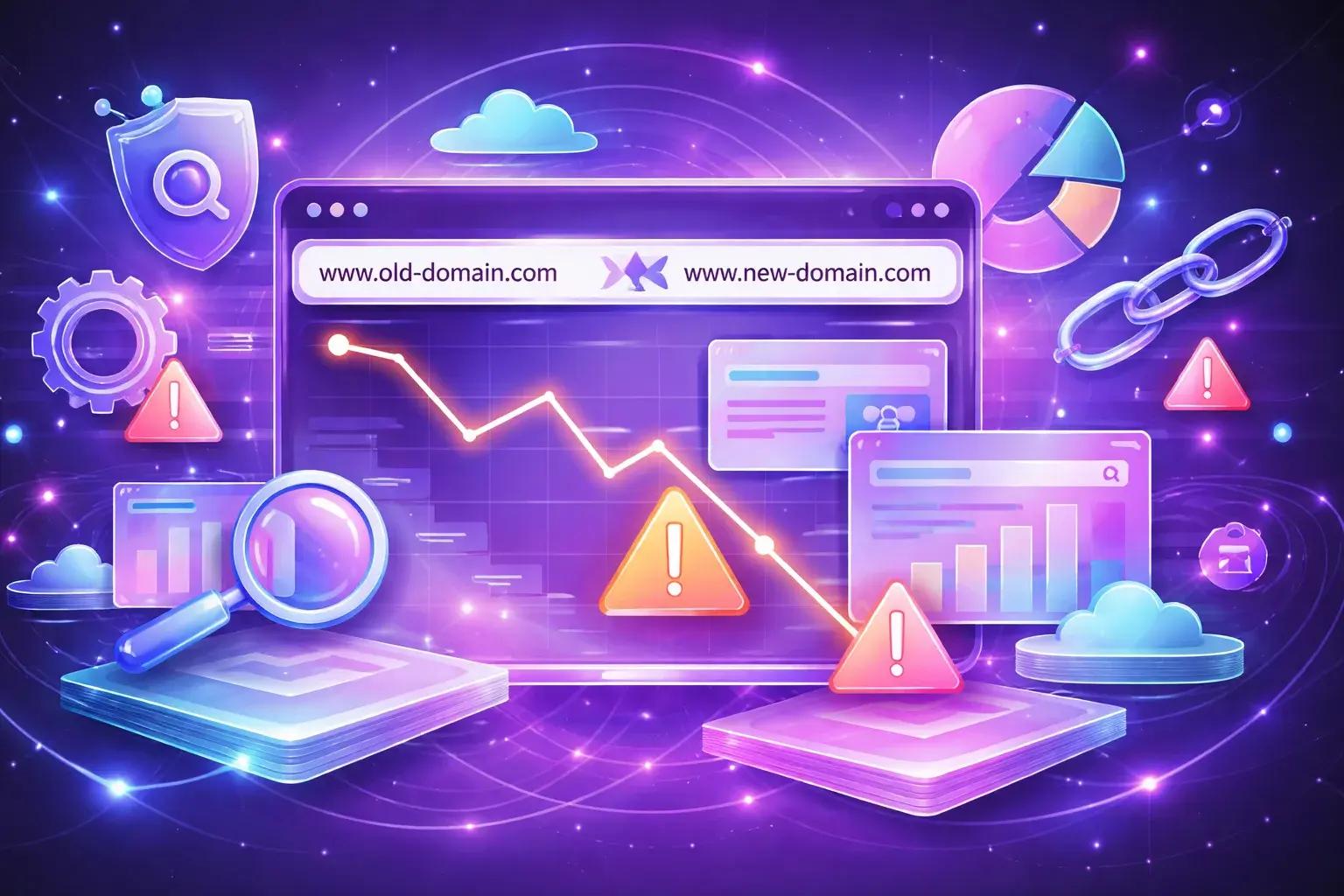
Navigating the Perilous Waters: Understanding SEO Risks When Changing Your Domain
The decision to change your website's domain name, whether driven by a rebrand, a merger, or the pursuit of a more memorable URL, often feels like a significant step forward for a business. It's a strategic move with considerable potential, yet beneath the surface of excitement lies a complex web of SEO risks that, if not meticulously managed, can severely impact your digital presence. Many business owners underestimate the intricate dance between a domain change and search engine algorithms, viewing it as a mere technical formality rather than a critical migration.
This oversight can lead to a precipitous drop in organic rankings, a dramatic loss of hard-earned traffic, and a significant erosion of brand authority built over years. Search engines like Google, Bing, and even AI Answer Engines rely on a vast array of signals tied directly to your domain – from backlink profiles and historical data to user engagement metrics. When you change your domain, you're essentially asking these complex systems to re-evaluate and re-assign all that accumulated trust and authority to a new address, a process fraught with potential missteps and misunderstandings.
Understanding these inherent SEO risks isn't about fostering fear; it's about empowering you with the foresight to plan, execute, and monitor a domain migration with the precision it demands. This guide will dissect the critical SEO vulnerabilities associated with a domain change, providing an expert-level overview that equips you to protect your digital assets and ensure a smooth, successful transition without sacrificing your valuable search engine visibility.
The Core SEO Risks Associated with Domain Changes
A domain change is far more than a simple URL update; it's a fundamental shift in your website's identity from a search engine's perspective. Each of the following risks carries the potential for significant negative impact on your SEO performance.
1. Loss of Organic Rankings and Traffic
- Algorithm Re-evaluation: Search engines need to re-crawl, re-index, and re-evaluate the authority and relevance of your new domain. This process is not instantaneous and can result in temporary, or even prolonged, ranking fluctuations.
- Historical Data Reset: While search engines attempt to transfer historical data, the transition period can appear as a "reset" to algorithms, potentially diminishing the accumulated trust and authority of your old domain.
- SERP Volatility: Expect to see your positions in Search Engine Results Pages (SERPs) become highly volatile. Pages that once ranked prominently might disappear or drop significantly until the new domain is fully recognized and trusted.
2. Erosion of Backlink Equity and Authority
- Broken Backlinks: The most immediate and damaging risk. Any external website linking to your old domain will now point to a non-existent page unless proper redirects are in place. Even with redirects, a small percentage of link equity can be lost in the transfer.
- Loss of Domain Authority/Rating: Metrics like Domain Authority (DA) or Domain Rating (DR) are tied to the specific domain. While 301 redirects pass most link equity, the new domain starts with a fresh slate in terms of its direct authority score, which can take time to rebuild.
- Anchor Text Relevance: Existing backlinks often use specific anchor text relevant to your old domain. If not carefully managed, this relevance might be diluted during the transition.
3. Technical Implementation Errors
- Incorrect 301 Redirects: The cornerstone of a successful domain migration. Failure to implement comprehensive, page-level 301 redirects from every old URL to its corresponding new URL is catastrophic. Incorrect redirects (e.g., 302s, 404s, or redirecting all old pages to the new homepage) will lead to massive SEO losses.
- Canonical Tag Issues: Incorrectly configured canonical tags on the new domain can signal duplicate content, confusing search engines and hindering indexing.
- XML Sitemap and Robots.txt Misconfigurations: Failing to update your XML sitemap with new URLs and submitting it to search engines, or incorrectly configuring your robots.txt file to block important pages, can prevent proper crawling and indexing.
- Internal Link Breakage: All internal links on your website must be updated to point to the new domain. Overlooking this creates a poor user experience and dilutes internal link equity.
4. Indexing and Crawling Delays
- Slow Re-indexing: Search engines take time to discover, crawl, and index all pages on your new domain. During this period, your content may not appear in search results.
- Duplicate Content Concerns: If both the old and new domains remain accessible without proper redirects, search engines might perceive duplicate content, leading to penalties or confusion about which version to rank.
- Google Search Console "Change of Address" Tool: While crucial, this tool is a signal, not a guarantee of instant transfer. Errors in its use can prolong the transition.
5. User Experience (UX) Disruption
- Broken Bookmarks: Users who have bookmarked old URLs will encounter 404 errors if redirects aren't perfect.
- Outdated Cache: Search engines and browsers might temporarily serve cached versions of your old site, leading to confusion.
- Brand Recognition: Users accustomed to your old domain might initially struggle to find your new one, impacting direct traffic and brand recall.
6. Impact on Local SEO (GEO)
- NAP Consistency: For businesses with a physical presence, a domain change necessitates updating your website URL across all local citations (Google My Business, Yelp, directories, etc.). Inconsistent Name, Address, Phone (NAP) information can severely damage local search rankings.
- Local Pack Visibility: Any disruption to your website's authority or accessibility can cause your business to drop out of the coveted local pack results.
7. Answer Engine Optimization (AEO) and Featured Snippets
- Loss of Featured Snippets: Featured Snippets, People Also Ask boxes, and other rich results are highly domain-dependent. A domain change can cause you to lose these valuable positions as AI Answer Engines re-evaluate your content's authority and relevance on the new domain.
- Knowledge Graph Disruption: If your brand is established in the Knowledge Graph, a domain change can temporarily disrupt this association, impacting how AI models understand and present information about your entity.
Mitigating the Risks: A Strategic Imperative
While the risks are substantial, they are not insurmountable. A successful domain migration hinges on meticulous planning, precise execution, and continuous monitoring. Engaging an experienced SEO strategist is not merely advisable; it is often critical to navigate these complexities. From comprehensive redirect mapping and updating all internal links to communicating with key stakeholders and monitoring performance metrics post-migration, every step must be handled with expert care.
Ignoring these SEO risks is akin to sailing into a storm without a compass. A domain change is a powerful strategic tool, but its success in the digital landscape is inextricably linked to a deep understanding and proactive management of its inherent SEO challenges. Protect your investment, preserve your rankings, and ensure your new domain truly represents a step forward.